Natural Nootropics: Nourishing the Intelligence of the Body and Consciousness
What the word nootropic really means
The word comes from Greek: noos (mind) + tropein (to turn toward). A nootropic is a substance that turns the mind toward its best version — not by forcing it, but by nourishing it.
It's not a stimulant. Caffeine pushes. A nootropic builds. It nourishes neurotransmitters, protects neurons, stimulates neurogenesis — the birth of new brain connections. The difference? A stimulant borrows energy from the future. A nootropic creates it.
Our bars are built on this principle. Each formula targets a specific neurotransmitter — not by chance, but with the precision of an engineer of the living world.
The 4 neurotransmitters we target
Serotonin — the inner sun. Mood, serenity, sleep. Our Safran & Lucuma bar nourishes it with saffron (the most studied spice for mood), lucuma and maca.
Acetylcholine — the laser. Focus, memory, learning. Our Matcha & Brahmi bar combines Japanese matcha (L-theanine + caffeine in perfect ratio) with brahmi, the memory plant in Ayurveda for 3,000 years.
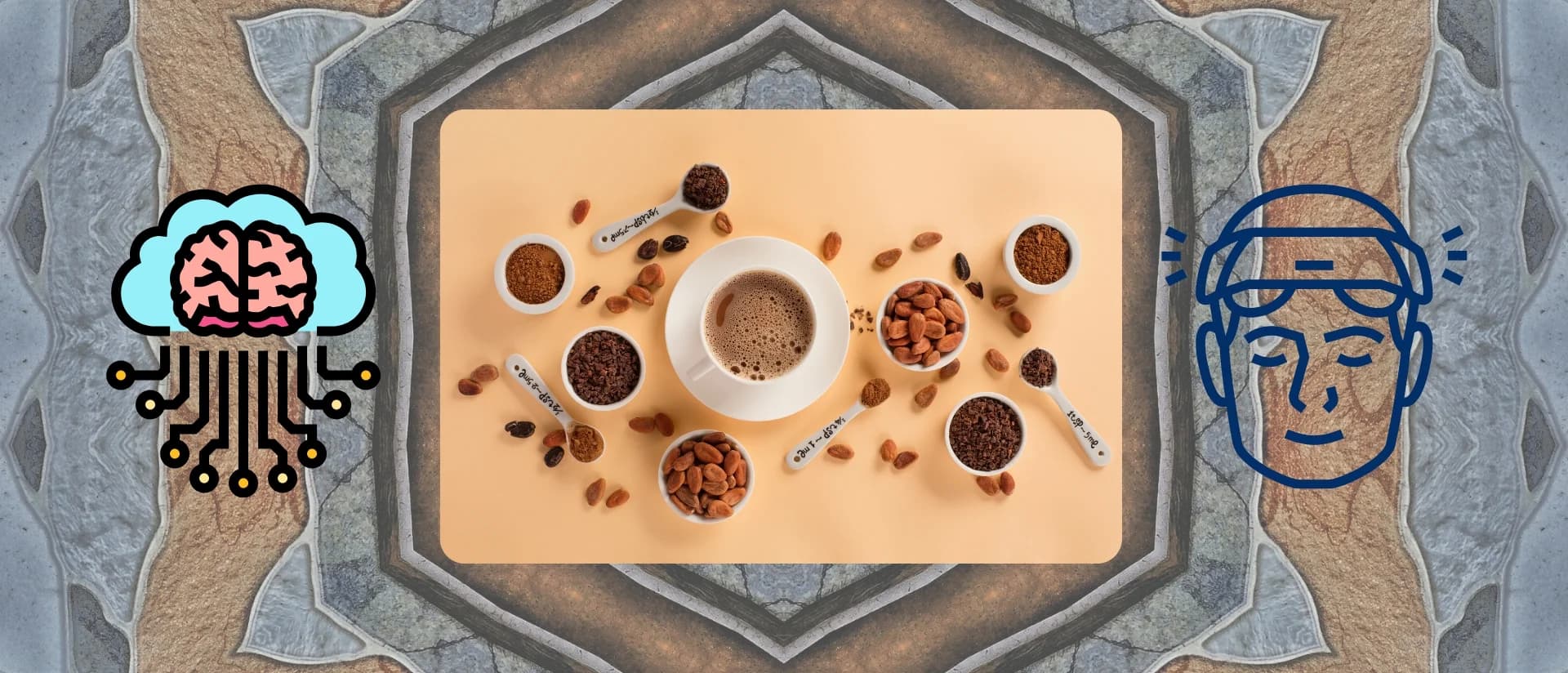
Dopamine — clean fire. Motivation, creativity, drive. Our Truffe de Cacao Cru uses raw Criollo cacao whose theobromine and PEA naturally activate dopamine — no crash, no dependency.
GABA — presence. Deep calm, letting go, recovery. Our Framboise & Ashwagandha bar combines CBD (endocannabinoid system) and ashwagandha, Ayurveda's great calming root, for a calm that isn't torpor — but lucidity.
Vibrational scale of nootropics
BU — Bovis units
The nootropic superfoods in our formulas
Phycocyanin (blue spirulina) — the protein of light. It's the blue pigment of spirulina, extracted and concentrated: the protein that captures light for photosynthesis, studied for its antioxidant activity. We associate it with prana, with a clear energy. Our Vanille & Spiruline Bleue bar contains a significant dose.
Brahmi (Bacopa monnieri) — Ayurveda's memory plant for millennia. Science has followed: in several human trials, twelve weeks of brahmi extract went hand in hand with better learning and memory scores.
Ashwagandha (Withania somnifera) — the royal adaptogen, ranked by Ayurveda among the rasayana, the plants of vitality. In trials run in India and Australia, two months of root extract (240 to 600 mg a day) saw cortisol, the stress hormone, fall by 23 to 30%, and sleep grow deeper.
Rhodiola rosea — the performance adaptogen. Studied in Russia and Scandinavia since the 1960s for resistance to fatigue, of body and mind alike: Soviet researchers tested it with their cosmonauts and athletes.
Lion's Mane (Hericium erinaceus) — the neurogenesis mushroom. In the laboratory, its hericenones and erinacines stimulate the production of NGF (Nerve Growth Factor), the protein that grows and maintains neurons — literally their fertilizer. Japanese researchers have been studying it since 1991.
Ceremonial matcha — L-theanine + caffeine in perfect ratio. L-theanine calms without drowsiness. Caffeine stimulates without agitation. Together, they create a state of alert, serene focus — what Zen monks have known for centuries.
The difference between nourishing and stimulating
Most people live on stimulants — coffee, sugar, notifications. The body borrows, borrows, borrows. And one day it collapses.
The nootropic approach is the opposite: we deposit. We build. Each bar is a dose of construction — building blocks for neurotransmitters, antioxidants for protection, adaptogens for resilience.
It's the difference between a candle flickering in the wind and a fire crackling in the hearth all night long. Both give light. Only one truly warms us.
As I write in my Full Power article: "Most people have never known their own brain at its full potential. It's not an exceptional state — it's the natural state of the well-nourished brain."
The newsletter
Keep reading
A recipe, a discovery, a report with the growers, upcoming gatherings.